
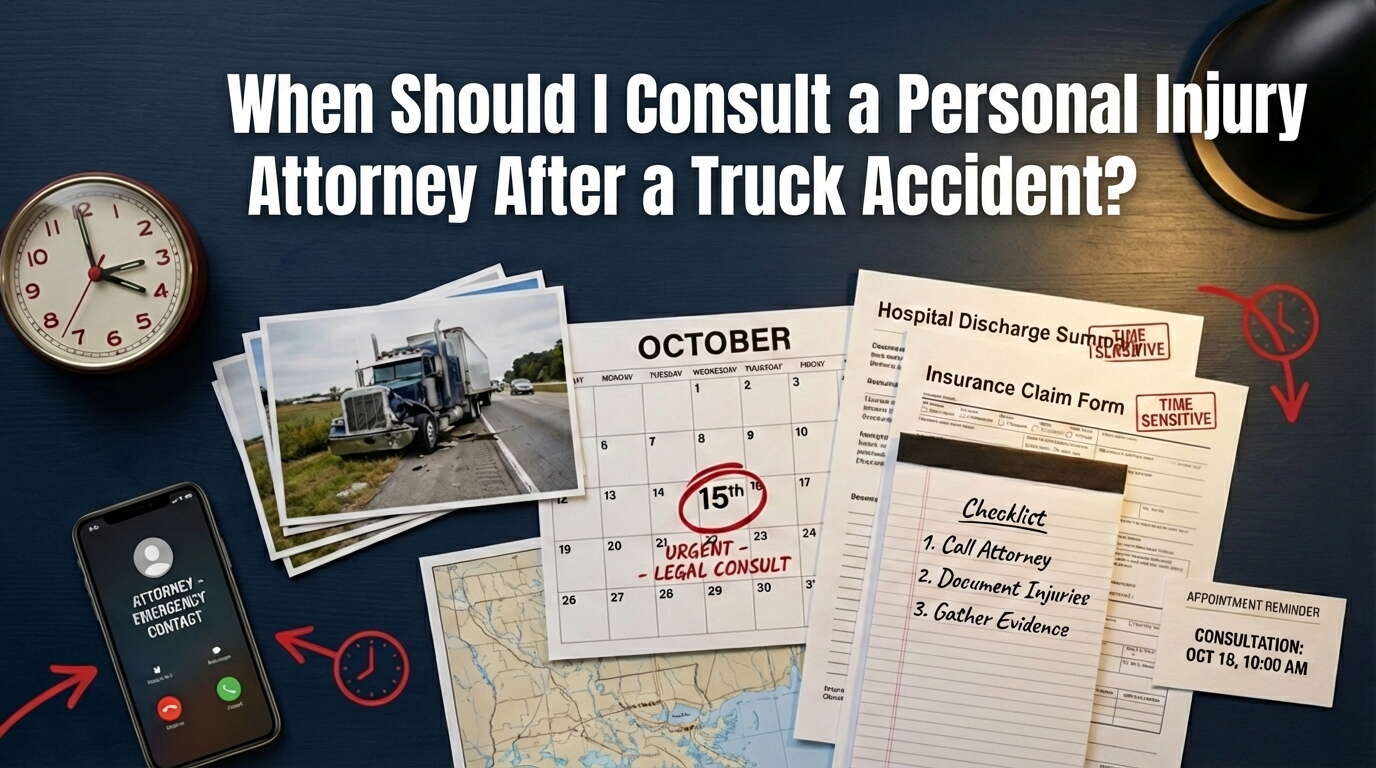
When to Consult a Truck Accident Attorney in Louisiana
Updated November 2026
The Short Answer: Talk to a truck accident attorney as soon as you are safe and have had medical care, and before you give a recorded statement to the trucking company’s insurer. In Louisiana, the carrier holds the driver logs, maintenance files and electronic data that show fault, and federal rules let it discard some of those records within months. For most crashes on or after July 1, 2024, the deadline to file suit is two years.
Signs It Is Time to Call a Truck Accident Lawyer
You do not need to have every answer before a consultation. Any one of these is a good reason to call:
- You were hurt badly enough to need medical treatment, or you are still dealing with the injury weeks later.
- The other vehicle was a commercial truck: an 18-wheeler, delivery truck, dump truck or tanker driven for a company.
- The trucking company or its insurer has called you, asked for a recorded statement, or made an early offer.
- Fault is disputed, or the crash report does not match what happened.
- You suspect a mechanical cause, such as brakes, tires, lights or a trailer that came loose.
- More than one company may share the blame, such as a carrier, a shipper, a repair shop or a leasing company.
- A family member died in the crash.
Sean Regan Law handles commercial vehicle accident claims for people hurt in New Orleans, Metairie, Kenner and surrounding Louisiana communities. The first consultation is free, and you can set it up by phone, email or Zoom.
People killed in large-truck crashes (70% were other vehicle occupants)
People injured in truck-involved crashes annually
Fully loaded semi-truck weight vs. 4,000 lbs average car
The Unseen Dangers: Why Truck Accidents Are Different and More Devastating
The distinction between a passenger vehicle accident and a truck accident lies in several critical factors, each raising the stakes and complicating the path to recovery. These differences are why truck claims call for a lawyer who handles trucking cases, not only car wrecks.
The Scale of Impact and What It Means for Your Claim
The physics of a truck crash are different from a crash between two cars. A fully loaded semi-truck can weigh up to 80,000 pounds, so its impact carries far more force. That size gap is why the stakes in a truck claim are usually higher than in a typical car crash claim.
When injuries are serious, the claim has to account for treatment and costs that may continue long after the emergency room visit. Keeping every medical record, bill and work note from the start makes those losses easier to prove later.
Federal Regulations and Complex Liability
The trucking industry is heavily regulated, with federal and state laws governing everything from driver hours and maintenance schedules to cargo loading and vehicle specifications. These regulations, overseen by the Federal Motor Carrier Safety Administration (FMCSA), are designed to keep trucks safe. A truck accident often involves a violation of one of them.
Determining fault requires a working knowledge of these rules. For instance, driver fatigue, a common contributing factor, is often linked to violations of Hours of Service (HOS) rules. Showing that a trucking company or driver broke these rules is a key part of establishing liability, a task far beyond the scope of typical personal injury claims.
The Power of Commercial Insurers and Dedicated Legal Teams
When a truck accident occurs, victims often find themselves facing not just the trucking company, but also its large, well-funded commercial insurance company. These insurers employ experienced adjusters and legal teams whose primary objective is to minimize the payout on claims. They often have significant resources dedicated to investigating accidents, defending against claims, and settling for the lowest possible amount.
This creates a pronounced imbalance of power, where an individual without legal representation is at a significant disadvantage against sophisticated corporate entities determined to protect their bottom line. The complexities of insurance policies and corporate defense strategies call for an equally capable advocate.
Louisiana FMCSA Law: Understanding Federal Trucking Regulations
FMCSA Violations as Evidence of Fault in Louisiana
Louisiana courts decide fault using a duty-risk analysis: did the driver or company owe a duty, break it, and cause the harm. A violation of a Federal Motor Carrier Safety Administration (FMCSA) rule does not automatically prove negligence. It is strong evidence of the standard a careful driver or carrier should have met, and when the violation ties directly to how the crash happened, it can carry real weight.
Key FMCSA Regulations:
- 49 CFR 395.8(e): Prohibits falsifying driver logs or disabling electronic logging devices (ELDs)
- 49 CFR 395.8(a): Requires tracking driver hours when ELDs are mandated
- Hours of Service (HOS) Rules: 11-hour driving limit after 10 consecutive hours off duty, and no driving after the 14th consecutive hour following the start of the duty period
- 49 CFR 393.9: Requires functional lamps and lighting equipment at all times
- Maintenance Requirements (49 CFR Part 396): Systematic inspection, repair and maintenance, with records the carrier must keep
How This Impacts Your Claim: If driver logs show Hours of Service violations and a fatigued driver caused your crash, that violation helps show what went wrong and that the carrier fell below rules it was required to follow. It does not settle the case on its own. The claim still has to connect the violation to the crash and to your injuries, which is where the logs, data and witness accounts come in.
Vicarious Liability: Louisiana law also holds employers responsible for harm their employees cause while doing their jobs (Louisiana Civil Code article 2320). That means a trucking company can answer for its driver’s conduct on the job. Companies can also face negligent hiring or retention claims if they failed to properly vet drivers or ignored red flags in driver records.
Why This Matters: FMCSA violations usually show up in driver logs, ELD data, maintenance files and the truck’s event data recorder, and some of those records have short federal retention periods. An experienced Louisiana truck accident attorney sends a preservation letter early so the carrier is on notice to keep them.
Louisiana Truck Accidents Caused by Maintenance Issues
Brake, tire, lighting and coupling failures often trace back to skipped inspections or put-off repairs, not to the driver alone. Federal rules in 49 CFR Part 396 require motor carriers to inspect, repair and maintain their trucks and trailers, and to keep records of that work.
The records that matter most in a maintenance case include:
- Maintenance and repair records (49 CFR 396.3): kept for one year while the truck is in the carrier’s control, and for six months after it leaves.
- Driver vehicle inspection reports (49 CFR 396.11): where drivers report defects they find. The carrier must certify that reported defects were repaired before the truck runs again, and keeps these reports for three months.
- Annual inspection records (49 CFR 396.17): each truck must pass a periodic inspection at least once every 12 months.
Responsibility for a maintenance failure can reach the motor carrier, an outside shop that did the work, a company responsible for maintaining a leased trailer, or a parts manufacturer if the part itself was defective. A Louisiana truck accident attorney looks at maintenance issues early, asking for these records and for access to the truck before repairs or salvage change what can be inspected.
Immediate Action: How a Lawyer Protects Your Claim from Day One
The days and weeks after a truck accident are when evidence is easiest to secure and early mistakes are easiest to avoid. Getting a lawyer involved during this window protects options you may need later.
Crucial Evidence Preservation and Preventing “Spoliation”
Why timing matters: Evidence in truck cases does not stay put. Federal rules let carriers discard driver vehicle inspection reports after three months (49 CFR 396.11) and hours-of-service records after six months (49 CFR 395.8), and the truck itself may be repaired or sold. A preservation letter asks the carrier to keep the electronic data from the truck’s “black box” (Event Data Recorder), driver logs, maintenance records, GPS data, and dashcam footage. Destroying evidence after notice of a claim is called “spoliation,” and Louisiana courts can treat it as a reason to presume the missing evidence would have hurt the party that destroyed it.
Navigating the Perils of Insurance Company Communication
After an accident, the opposing insurance company will likely contact you quickly, expressing sympathy and requesting a recorded statement. Understand that their agents are not your allies. What you say can be used to reduce the value of your claim or deny it entirely. They may offer a quick, low settlement before you fully understand the extent of your damages. A lawyer can act as your point of contact, shielding you from these conversations. Learn more about protecting your rights when you’re not at fault.
Understanding the Prescriptive Period (Statute of Limitations)
Louisiana calls its filing deadline a prescriptive period (other states call it a statute of limitations). For most injury claims from truck accidents on or after July 1, 2024, the prescriptive period is two years from the date of the accident (Louisiana Civil Code article 3493.11). Accidents before that date fall under the older one-year period. Different rules and notice requirements can apply, including claims against a government entity and maritime claims, so confirm the deadline for your situation early. Missing it can end your right to recover in court. Read our complete guide on the car accident lawsuit timeline.
Building Your Case: The Lawyer’s Investigative and Analytical Expertise
Pursuing a truck accident claim takes more than documenting an injury. It takes a careful investigation to establish fault and prove negligence, and this is where a lawyer who handles trucking claims earns their place.
Meticulous Accident Investigation and Expert Evidence Gathering
A thorough investigation is the bedrock of any strong truck accident claim. This process often involves more than reviewing police reports. A seasoned attorney will work with accident reconstructionists, mechanical engineers, and medical experts to analyze the crash scene, the involved vehicles, and the nature of the victim’s injury. They will interview witnesses, gather photographic and video evidence, and examine all available data from the truck’s systems. This approach helps identify all contributing factors, whether they stem from driver error, mechanical failure, improper loading, or hazardous road conditions.
Pinpointing Liability: Unraveling the Multi-Party Responsibility
Truck accidents rarely involve a single party at fault. Liability can extend to:
- The truck driver
- The trucking company (owner, operator, or employer)
- The cargo loader or shipper
- The vehicle or parts manufacturer
- The maintenance company
- Government entities responsible for road maintenance
Identifying all potentially liable parties takes an understanding of how trucking companies, shippers and contractors are set up and how they work together. An experienced injury lawyer traces those relationships so that every party that contributed to the accident is identified and held accountable for its share.
Proving Negligence and Causation: The Foundation of Your Claim
To win a truck accident claim, it is essential to prove two key elements: negligence and causation. Negligence occurs when a party fails to exercise the reasonable care that a prudent person would exercise under similar circumstances. This could involve speeding, driver fatigue, distracted driving, or inadequate vehicle maintenance. Causation means demonstrating that this negligence directly led to the accident and the resulting injury or damages. Proving these elements often requires piecing together technical evidence, expert testimony, and the accounts of witnesses.
Maximizing Compensation: Valuing the True Cost of Your Injury
The goal of a truck accident claim is fair compensation for all the losses an injured person has sustained. That often means calculating damages that go far beyond immediate medical bills.
Comprehensive Calculation of Economic Damages
Economic damages are tangible financial losses directly attributable to the accident. An experienced lawyer will carefully calculate:
- Past and Future Medical Expenses: Hospital stays, surgeries, medication, physical therapy, long-term care
- Lost Wages: Current income lost and diminished earning capacity from injury
- Vocational Rehabilitation: Retraining costs if you cannot return to your previous occupation
- Property Damage: Cost of repairing or replacing the vehicle
- Other Out-of-Pocket Expenses: Related to the accident and recovery
Accounting for Non-Economic Damages: Pain, Suffering, and Lost Quality of Life
Beyond quantifiable economic losses, a truck accident claim can include non-economic damages:
- Physical pain and suffering
- Emotional distress and mental anguish
- Diminished enjoyment of life
- Loss of companionship (consortium)
An attorney will work to explain and document these losses so that any settlement or verdict reflects the full human cost of the accident. Learn more about maximizing your injury settlement.
Special Considerations: Wrongful Death Claims
When a truck accident results in a death, surviving family members may have grounds for a claim. Louisiana recognizes two related actions: a wrongful death action for the family’s own losses (Louisiana Civil Code article 2315.2), and a survival action for what the person who died suffered before death (article 2315.1). Who may bring these claims is set by law, starting with a spouse and children.
These damages can include the financial support the person would have provided, the loss of guidance and companionship, and funeral and burial expenses. Pursuing a wrongful death claim is emotionally taxing, and families deserve an advocate who is patient with them and firm with the other side.
The Legal Journey: Negotiation, Litigation, and Securing Justice
The legal process after a truck accident can feel daunting. With representation, a claim can be resolved through settlement or, when needed, trial.
Skillful Negotiation with Aggressive Insurance Adjusters
The majority of truck accident claims are resolved through settlement negotiations rather than going to trial. Armed with evidence and a clear picture of the law and the extent of the victim’s damages, an experienced attorney can counter the tactics of insurance adjusters. They push for a settlement that reflects the full extent of the losses, advise whether an offer is worth accepting, and protect the injured person’s rights throughout the process.
Preparing for Trial: When Litigation Becomes Necessary
If a fair settlement cannot be reached through negotiation, the case may proceed to litigation. This involves filing a lawsuit and engaging in a more formal legal process, including discovery (exchanging evidence and taking depositions), filing motions, and potentially going to trial before a judge and jury. An adept accident lawyer will meticulously prepare the case for trial, understanding that the opposing side is more likely to offer a reasonable settlement if they believe the plaintiff is prepared to win in court.
The Advantage of Experienced Legal Representation
An experienced attorney helps at every stage of the claim. Familiarity with truck accident cases, industry rules and the strategies of the opposing side matters, as does the ability to run a thorough investigation and bring in the right witnesses. It also takes the work of managing the claim off your plate, so you can focus on recovery.
Choosing Your Advocate: What to Look for in a Truck Accident Lawyer
Selecting a lawyer is a decision that can shape the outcome of your truck accident claim. Not all attorneys are equally equipped to handle these cases.
Experience With Truck Accident Claims
Trucking litigation is a distinct area of personal injury law, governed by specific federal and state regulations and involving unique investigative challenges. Look for a New Orleans personal injury lawyer who has real experience handling truck accident cases. They should know the FMCSA regulations, the common causes of truck crashes, and the tactics trucking companies and their insurers use.
Proven Track Record and Comprehensive Resources
Experience with similar cases is a good indicator of an attorney’s capability, so ask about their history with truck accident claims. Also consider the resources available to the firm. Can they bring in the accident reconstructionists, medical professionals and economists a strong case may need, and give the case the attention it requires?
Transparent Fee Structure and Client-Centered Approach
Most truck accident lawyers work on a contingency fee basis, meaning they only get paid if you win your case, and their fee is a percentage of the compensation awarded. Ensure this arrangement is clearly explained, and understand any associated costs for expert evidence or filing fees. Equally important is a client-centered approach. Your lawyer should be accessible, communicative, and genuinely invested in your well-being and recovery. They should take the time to explain your options, answer your questions, and keep you informed throughout the process.
Sean Regan Law is a smaller firm, which lets Sean give each case personal attention. Sean Regan was born and raised in New Orleans, graduated from LSU and Loyola Law School, and began a legal career at personal injury firms in New Orleans before opening Sean Regan Law.
Why Timing Matters After a Truck Accident
The aftermath of a truck accident is hard, physically and emotionally. Waiting too long to get advice can also make the legal side harder.
The Critical Importance of Timely Legal Action
As noted above, Louisiana’s prescriptive period (statute of limitations) limits how long you have to file suit, and missing it can end the claim. Evidence can also be lost, altered, or discarded if it is not requested promptly. The longer you wait, the harder it becomes to gather what is needed to prove fault and show the full extent of your damages. An early consultation protects your rights from the outset.
Your Path to Recovery and Justice Begins Here
A truck accident can leave you dealing with serious injury, medical bills, and a legal process you never asked to learn. You do not have to handle it alone. A personal injury lawyer experienced in truck accident claims can act as your advocate, work to hold the responsible parties accountable, and pursue the compensation the law allows while you focus on your recovery.
Frequently Asked Questions About Truck Accident Claims
As soon as you are safe and have received medical care, and ideally before you speak with the trucking company’s insurer. Early contact gives your attorney time to request driver logs, maintenance records and event data recorder files while they still exist, and leaves plenty of room before the filing deadline.
For most injury claims from accidents on or after July 1, 2024, it is two years from the date of the accident. Accidents before that date fall under the older one-year period. Claims against a government entity and maritime claims can follow different rules, so confirm your deadline with an attorney early.
Usually, yes. Most truck accident attorneys work on a contingency fee, meaning the fee is a percentage of any settlement or verdict and is owed only if there is a recovery. Before you sign, ask how case costs and expenses, such as expert and filing fees, are handled. The first consultation with Sean Regan Law is free.
Several parties may share liability: the truck driver, the trucking company, the cargo loader or shipper, a vehicle or parts manufacturer, a maintenance company, or a government entity responsible for the road. Louisiana divides fault among everyone who contributed to a crash by percentage, so identifying every responsible party matters.
Conclusion: Talk to a Lawyer Early
Truck crash claims ask more of a lawyer than a typical car crash: federal safety rules, several possible defendants, insurers with large defense teams, and records that are not kept for long. That is why it helps to talk with a truck accident lawyer early, while the evidence is still there.
An attorney who handles these claims investigates the crash, checks for FMCSA violations and maintenance failures, and documents every category of loss so the claim reflects what the crash actually cost you. When you choose one, look for trucking experience, clear answers about fees and costs, and someone who keeps you informed.
If you were hurt in a truck crash in Louisiana, a free consultation with a Louisiana truck accident attorney at Sean Regan Law can tell you where your claim stands, what evidence to request, and how much time you have.
Injured in a Truck Accident? Call Sean Regan 24/7
(504) 888-7777Free Consultation • Commercial Vehicle and Truck Accident Claims • Available 24/7
This article is general information about Louisiana law and is not legal advice. Reading it does not create an attorney-client relationship. For advice about your situation, talk with a licensed Louisiana attorney.